Why This Photo Exists: Icelandic Horses
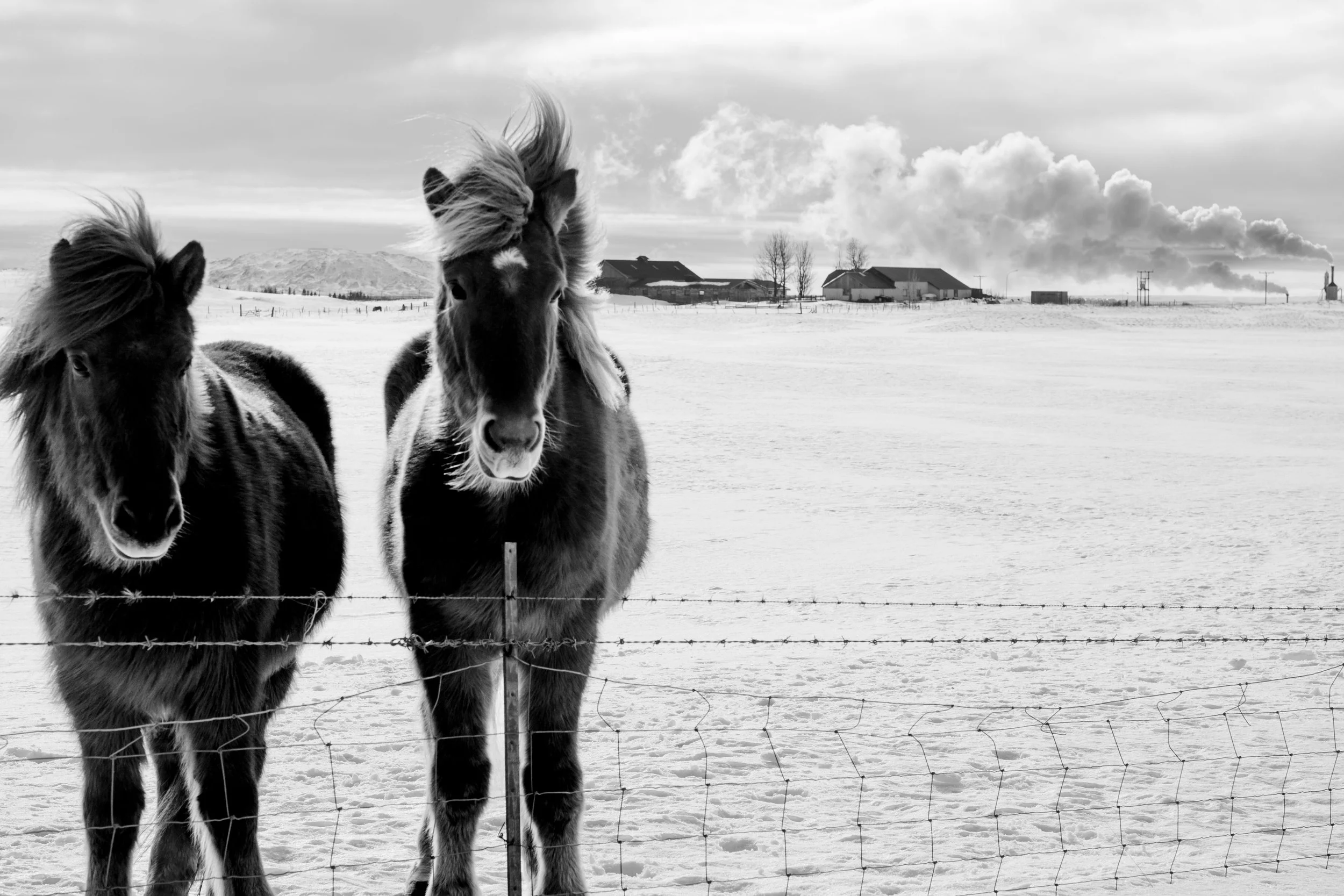
Iceland, 2016
This photo changed everything. Not all at once—quietly, the way important things often do.
I took it in Iceland, 2016. Two horses standing in the snow, their manes tangled by wind, watching me the way horses do—curious but unhurried. Behind them, steam rose from somewhere unseen, the land itself exhaling. At the time, it felt like just another frame. Another moment caught and filed away.
I almost forgot about it entirely.
Then, months later, I stripped the color out. And suddenly I saw it.
The composition I'd missed before—the way the horses anchor the left side of the frame, how the fence line draws your eye across the snow toward that distant plume of steam, the mountains barely visible through the haze. In color, I'd been distracted by... I don't even know what. The brown of their coats, maybe. The grey-blue of the sky. Details that added nothing.
Black and white swept all that aside. What remained was structure. Feeling. Two creatures standing in a vast, quiet world, looking back at me.
Here's the thing: this photo isn't sharp. It's soft in places where a technically "good" photograph wouldn't be. In color, that softness felt like failure. In black and white, it feels like breath. Like the image is alive in some small way.
I'd understood black and white for portraits—how it strips a face down to emotion, pulls viewers past the surface. What I hadn't understood was that it could do the same for everything. A landscape. A moment. Two horses in the snow.
Color photographs feel like memory to me. They say: this is what I saw. Black and white feels different. It says: this is what I felt. One preserves. The other interprets. And interpretation, I've come to believe, is where photography actually lives.
This image was the first to teach me that. It didn't just change how I edit—it changed how I see when I raise the camera to my eye.
It exists to remind me: the goal was never perfection.
The goal was always seeing.
